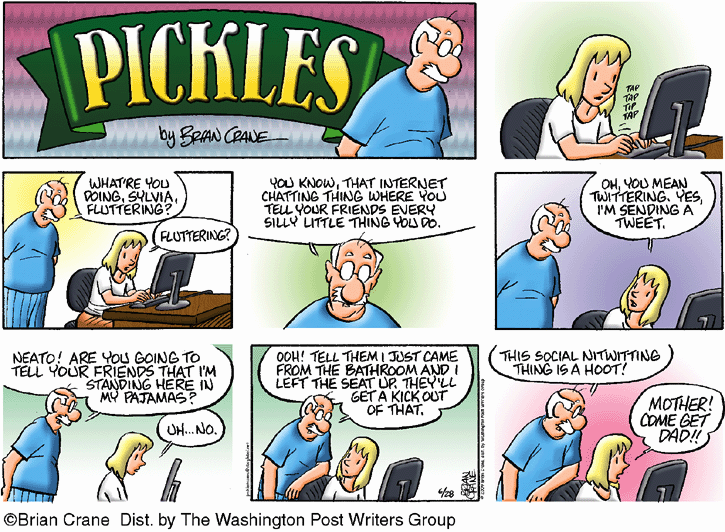
So it's time to brag on my grandson. He's in kindergarten and we're all interested in how he's adapting and learning new things. One of the adaptations is he, like all the other kids, have been taking standardized tests throughout the year to gauge his progress. Some of these tests adjust to how well the student is doing; if the kid is doing well, the questions get harder. My daughter discovered he was taking some of these tests this week and has more next week, so she asked him how it was going. After previous tests, he told her he was concerned because he was pretty sure he'd gotten some of the answers wrong. His mother assured him that it was OK if he didn't know all the answers and just did his best on the test. He did very well, but she figures, quite correctly, that at age 6 he doesn't need details about the results.
Anyway, this time he told her that some of the reading test was hard and he again wasn't sure he got them all right. In fact, he said, he had to alphabetize some words and he was pretty sure one of them was wrong, because all the words started with S. As my daughter was contemplating how to respond about more complex alphabetizing, my grandson continued on with something like "I wasn't sure what to do, so I just guessed and went with the second letters..."
As his mother has pointed out on numerous occasions, her eldest son is a problem solver! And that's another reason, since he's been in kindergarten, that I miss hanging out with him. It's fascinating watching a young mind develop and grow!
And while I'm reflecting on schools and students, congratulations to Teacher of the Year Rebecca Mieliwocki, who was honored in Washington, D.C. today. Her work is our future.
Showing posts with label education. Show all posts
Showing posts with label education. Show all posts
Tuesday, April 24, 2012


Thursday, February 10, 2011
What Do You Expect?
I am a big supporter of public education and always have been. I've been an elected public school Board of Education member since 1988 and graduated from public elementary and secondary schools. Most public schools are not nearly as ineffective as some politicians would have us believe, although there is certainly room for improvement. I've long campaigned for better funding sources for schools and a move away from the centuries old property tax system used in the U.S. to fund schools. But money isn't the only thing we need to fix in schools.
I think the most important aspect of education that needs to be addressed is our expectations; what do we expect the schools to accomplish? Every year, State legislatures generate a host of new objectives for schools to achieve, ranging from studying a particular subject (Lupus education), observing "Emancipation Proclamation Week," establish "diabetes care plans" for students, and requiring certain sex education courses to teach pupils about the dangers associated with drug and alcohol consumption during pregnancy. This is a very short list of recent legislative changes in Illinois. Whether these goals are laudable is not the point. Some legislative educational mandates are somewhat silly, but that's not the point either. Rather, the common thread is that a hugely wide variety of social objectives find their way into a finite school day. For every item added to the curriculum, something else disappears.
Therein lies the problem; public education seems to be focused on social issues and goals, at the expense of education. Society expects our public schools to teach kids everything, including things that parents should be addressing or very narrowly defined topics of study. Is it really necessary to formally require instruction on specific diseases in elementary/secondary schools?
In a recent Marketplace article, educator Michelle Rhee points out that operating schools based on social goals rather than, economic objectives, results in one very large problem whenever the economy sours.
Ms. Rhee suggests that we are not honest with our children about their abilities and accomplishments, and instead flood them with trophies, ribbons, and other confirmations that whatever they've done, it meets expectations. Even if it's pretty mediocre performance.
I think she's right, and it's not limited to sports. Just look at all the "reality" TV shows to which many Americans are apparently addicted. Many, if not most, glorify mediocre so-called "accomplishments" and behaviors. Is that all we expect from people, including our kids? Is that why the talking heads seem to think we all want a person "just like us" to be leader of the U.S.? Let's be honest about this expectation also. I want someone "smarter than the average bear" to lead the nation.
Rhee proposes we change from this culture of complacency:
I think the most important aspect of education that needs to be addressed is our expectations; what do we expect the schools to accomplish? Every year, State legislatures generate a host of new objectives for schools to achieve, ranging from studying a particular subject (Lupus education), observing "Emancipation Proclamation Week," establish "diabetes care plans" for students, and requiring certain sex education courses to teach pupils about the dangers associated with drug and alcohol consumption during pregnancy. This is a very short list of recent legislative changes in Illinois. Whether these goals are laudable is not the point. Some legislative educational mandates are somewhat silly, but that's not the point either. Rather, the common thread is that a hugely wide variety of social objectives find their way into a finite school day. For every item added to the curriculum, something else disappears.
Therein lies the problem; public education seems to be focused on social issues and goals, at the expense of education. Society expects our public schools to teach kids everything, including things that parents should be addressing or very narrowly defined topics of study. Is it really necessary to formally require instruction on specific diseases in elementary/secondary schools?
In a recent Marketplace article, educator Michelle Rhee points out that operating schools based on social goals rather than, economic objectives, results in one very large problem whenever the economy sours.
(In America w)e see education as a social issue, not an economic one. And what happens to social issues in times of economic hardship? They get swept under the rug.Joining those social issues underneath the rug, are our educational system support and issues.
Ms. Rhee suggests that we are not honest with our children about their abilities and accomplishments, and instead flood them with trophies, ribbons, and other confirmations that whatever they've done, it meets expectations. Even if it's pretty mediocre performance.
I think she's right, and it's not limited to sports. Just look at all the "reality" TV shows to which many Americans are apparently addicted. Many, if not most, glorify mediocre so-called "accomplishments" and behaviors. Is that all we expect from people, including our kids? Is that why the talking heads seem to think we all want a person "just like us" to be leader of the U.S.? Let's be honest about this expectation also. I want someone "smarter than the average bear" to lead the nation.
Rhee proposes we change from this culture of complacency:
In Korea, they have this culture that focuses on always becoming better. Students are ranked one through 40 in their class and everyone knows where they stand. The adults are honest with kids about what they're not good at and how far they have to go until they are number one. Can you imagine if we suggested anything close to that here? There would be anarchy.Maybe we could use a little anarchy in this country.
Friday, July 30, 2010
For Profit Colleges-Big Money Being Made
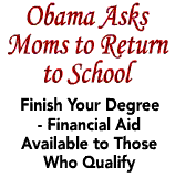
As usual, follow the money... These schools are making huge profits at the expense of many students and, ultimately, the U.S. taxpayer (we foot the bill for those college loans these schools depend on).
Tuesday, June 29, 2010
Good News From The Big City
It probably doesn't matter much which big city you live near. The bulk of the news coming from "the city" sometimes seems to be mostly some sort of body count. At the beginning of each week, the newspapers often (usually) have articles counting how many gunshot incidents occurred over the week-end, how many people were injured, and how many were killed. In Chicago, all too often, the victims of all this violence are young people. It gets very depressing, and I don't even actually live in the city. I can hardly imagine how this kind of carnage affects residents of the areas with all the violence.
That said, sometimes there is a glimmer of hope, a spot of sunshine in an otherwise dismal day of news. There was such a glimmer in the news here the other day about a graduating class at Urban Prep High School (a link to the article is below.) This school was created as a charter school in Chicago with lofty goals:
You should read the AP article in the Daily Herald. The story is amazing and uplifting. It's very good news from the city.
That said, sometimes there is a glimmer of hope, a spot of sunshine in an otherwise dismal day of news. There was such a glimmer in the news here the other day about a graduating class at Urban Prep High School (a link to the article is below.) This school was created as a charter school in Chicago with lofty goals:
So, here we are four years later. Of the 150 teens who started at Urban Prep in 2006, 95 completed the entire four years and another 12 students transferred in to graduate with the class of 2010. All 107 students have received at least one, and generally several, acceptance letters from colleges across the country. I was struck by the fact that the article doesn't paint a "Pollyanna" picture, it discusses the trials and difficulties that these students encountered over the four years, including actually quitting, returning to a "public" high school, and discovering that they wanted, indeed needed, to return to Urban Prep. The dedication and support provided by the staff at the high school is nothing short of amazing (60% of the faculty are black men). The mentoring and modeling by the adults was clearly critical to the success of these students. Both the students and faculty at Urban Prep deserve a long, hearty round of applause.Urban Prep would be a charter high school. It would bring together some 150 boys from some of the poorest, gang-ravaged neighborhoods and try to set them on a new track. They'd have strict rules: A longer school day -- by two hours. Two classes of English daily. A uniform with jackets and ties. And Urban Prep had a goal -- one that seemed audacious, given that just 4 percent of the Class of 2010 was reading at or above grade level when they arrived at the school in 2006.In four years, they were told, they'd be heading to college.
You should read the AP article in the Daily Herald. The story is amazing and uplifting. It's very good news from the city.
Sunday, April 4, 2010
Why Care About The Weirdness In Texas?
The weirdness in question is the behavior of the Texas School Board, which has been in the news lately regarding it's curriculum adoptions. The Board has been controlled by a group of what many refer to as extremist evangelicals who have determined that all school textbooks in Texas must follow their agenda, which apparently is not primarily based on facts, but on their beliefs. Case in point: Texas textbooks must teach that the US was founded as a "Christian nation." The historical evidence is quite the contrary, as this article in the Chicago Tribune points out in some detail. The list of historical distortion and rewriting is long; read the NY Times article for the gory details.
Why care about what some goofballs in Texas are doing? Because Texas is so large, and because it purchases so many school textbooks, what it says must be in those textbooks is closely followed by publishers. The result is that those same books are used in most schools around the country, regardless of whether those other schools subscribe to the one-sided and less-than-factual "curriculum."
What can you do about it? Hope that most schools ditch large purchases of textbooks in favor of electronic media sooner rather than later.
Why care about what some goofballs in Texas are doing? Because Texas is so large, and because it purchases so many school textbooks, what it says must be in those textbooks is closely followed by publishers. The result is that those same books are used in most schools around the country, regardless of whether those other schools subscribe to the one-sided and less-than-factual "curriculum."
What can you do about it? Hope that most schools ditch large purchases of textbooks in favor of electronic media sooner rather than later.
Sunday, August 2, 2009
Teach Your Children
Have I mentioned that I bike ride most every day (weather permitting)? It's the only form of exercise that I actually enjoy, and I try to get out every morning to do about a 6 1/2 mile course. Much of my route is in a local park, which has really nice walking/biking paths. The pavement is divided like a road with a yellow line down the center and there are mileposts marking distances throughout.
I normally ride in the morning and that generally means there are only a few people using the park, walking dogs, jogging, or just walking. It's pretty nice and everyone stays out of everyone else's way. Some days, my ride is delayed for one reason or another, and I don't get out for my ride until afternoon or early evening. Often, those rides are not so much fun.
Later in the day, when many more people are using the park, I'm finding many more people who don't have a clue how to use public spaces. It can be mothers with strollers, walking down the middle of the path, nearly blocking the way for joggers and bikers. Even worse, I often see two people pushing strollers down the path, side by side, completely blocking the path. Dog walkers with what seem to be 50 foot long leashes, with the walker on one side of the path and the dog about 25 feet off the path on the opposite side. With the leash blocking the path. That's not the dog's fault, it's the owners fault.
My biggest complaint about the clueless way people use public space (like parks) relates to children and they way they aren't getting much, if any, supervision or instruction. It's probably not surprising; if the parents are truly clueless about such things, why would anyone expect them to teach their children?
Today, there were hordes of small children on bikes and roller skates in the park. I'm talking mostly about kids in the 4-8 range on small two wheel bikes. They ride with their heads down, oblivious to what's in front of them, and wander back and forth across the path, not staying to one side or the other. My preference would be the general rules of the road which would suggest (in the U.S.) that you walk/ride on the right and pass on the left. I observed groups of 4-6 young kids scattered around the path, with no visible adult supervision. What supervision there was often was what appeared to be older siblings maybe a quarter mile behind the kids (which is to say there was no supervision).
More disturbingly, there was no education taking place (what President Obama calls "teachable moments"). No one appeared to be taking the time to explain to these young kids how to use the public space, how to share it with others, how to do it safely. It's sad to see this aspect of our community network failing so badly; it's not the schools' responsibility to do this, it's the family that should be teaching these behaviors.
Retired Supreme Court Justice David Souter just the other day gave a speech in which he lamented how little Americans understand about their government. One example is how few people can actually name the three branches of the Federal government. He attributes much of this to the lack of old-fashioned Civics classes in school. Perhaps what I've observed in the park is just a different aspect of what Justice Souter saw in court. Americans don't seem to have even a rudimentary grasp of what's going on around them and how people should interact with others in a socially acceptable and respectful way.
I suppose that if parents are clueless about yielding part of the park path to others, it's no surprise that many of them seem to drive cars the same way. This is just another aspect of what I already wrote about previously, but now it involves the cluelessness of the parents being passed on to their children. It's frustrating. Stephen Josephson talks about the need to "teach your children well," but again, if the parents are clueless, who can expect them to "model" the desired behaviors?
Once again, I have to return to that Ashleigh Brilliant quote: "I don't have any solution, but I certainly admire the problem."
I normally ride in the morning and that generally means there are only a few people using the park, walking dogs, jogging, or just walking. It's pretty nice and everyone stays out of everyone else's way. Some days, my ride is delayed for one reason or another, and I don't get out for my ride until afternoon or early evening. Often, those rides are not so much fun.
Later in the day, when many more people are using the park, I'm finding many more people who don't have a clue how to use public spaces. It can be mothers with strollers, walking down the middle of the path, nearly blocking the way for joggers and bikers. Even worse, I often see two people pushing strollers down the path, side by side, completely blocking the path. Dog walkers with what seem to be 50 foot long leashes, with the walker on one side of the path and the dog about 25 feet off the path on the opposite side. With the leash blocking the path. That's not the dog's fault, it's the owners fault.
My biggest complaint about the clueless way people use public space (like parks) relates to children and they way they aren't getting much, if any, supervision or instruction. It's probably not surprising; if the parents are truly clueless about such things, why would anyone expect them to teach their children?
Today, there were hordes of small children on bikes and roller skates in the park. I'm talking mostly about kids in the 4-8 range on small two wheel bikes. They ride with their heads down, oblivious to what's in front of them, and wander back and forth across the path, not staying to one side or the other. My preference would be the general rules of the road which would suggest (in the U.S.) that you walk/ride on the right and pass on the left. I observed groups of 4-6 young kids scattered around the path, with no visible adult supervision. What supervision there was often was what appeared to be older siblings maybe a quarter mile behind the kids (which is to say there was no supervision).
More disturbingly, there was no education taking place (what President Obama calls "teachable moments"). No one appeared to be taking the time to explain to these young kids how to use the public space, how to share it with others, how to do it safely. It's sad to see this aspect of our community network failing so badly; it's not the schools' responsibility to do this, it's the family that should be teaching these behaviors.
Retired Supreme Court Justice David Souter just the other day gave a speech in which he lamented how little Americans understand about their government. One example is how few people can actually name the three branches of the Federal government. He attributes much of this to the lack of old-fashioned Civics classes in school. Perhaps what I've observed in the park is just a different aspect of what Justice Souter saw in court. Americans don't seem to have even a rudimentary grasp of what's going on around them and how people should interact with others in a socially acceptable and respectful way.
I suppose that if parents are clueless about yielding part of the park path to others, it's no surprise that many of them seem to drive cars the same way. This is just another aspect of what I already wrote about previously, but now it involves the cluelessness of the parents being passed on to their children. It's frustrating. Stephen Josephson talks about the need to "teach your children well," but again, if the parents are clueless, who can expect them to "model" the desired behaviors?
Once again, I have to return to that Ashleigh Brilliant quote: "I don't have any solution, but I certainly admire the problem."
Monday, July 13, 2009
Loose Cannon On Campus?
A local story here involves a now former school board member who had been arrested for battery involving a group of students outside their high school. The full story is here. In brief, when he saw a group of students attempting to enter the school through a "restricted" door, he "ordered" them to follow him to the Dean's office. Along the way, he grabbed another student by the arm and ordered him to come along also. That student refused and filed a battery complaint against the school board member. Prosecutors eventually dropped the charge and the board member resigned from the board because he moved out of the district. He also took the opportunity to declare he'd done nothing wrong and that his actions made him a "hero."
The story is troubling for several reasons. My first concern is that comments on the newspaper story clearly indicate that many people have no clue what school board members are or what their job is. Many commenters lauded him for "doing the job he was hired for" and wondered why the prosecutors filed charges against him for "doing his job." He is not a "staff member." He was a school board member which is an elective office, not an employee of the District. He was totally out of line to attempt to herd a bunch of students to "the office."
Another issue is that school board members as individuals have no particular authority over students or even staff members of a school, or to enforce rules on campus. In fact, in Illinois, the oath of office for school board members states "...a Board member has no legal authority as an individual and that decisions can be made only by a majority vote at a public Board meeting." One school board member equals one citizen, nothing more, nothing less.
This guy is not a hero (since when do people get to declare themselves heroes?). If he thought the students were "behaving suspiciously," he should have called police, not intervene personally. His wife, who was with him in the car, and is a teacher at the high school, might have legitimately gotten involved. His claim that he was concerned about security at the high school rings hollow and sounds more like someone searching for a campaign slogan.
He is nothing more than a bully and the District is better off that he's now resigned. He clearly had no clue what the role of a school board member is and apparently didn't care very much about that small detail. For those who are petrified about students bringing guns or bombs to school, it can happen, but it doesn't get prevented by a board member who happens to be sitting in his car. It's prevented by adoption of procedures and rules by school boards and administrators, not by loose cannons on campus.
The story is troubling for several reasons. My first concern is that comments on the newspaper story clearly indicate that many people have no clue what school board members are or what their job is. Many commenters lauded him for "doing the job he was hired for" and wondered why the prosecutors filed charges against him for "doing his job." He is not a "staff member." He was a school board member which is an elective office, not an employee of the District. He was totally out of line to attempt to herd a bunch of students to "the office."
Another issue is that school board members as individuals have no particular authority over students or even staff members of a school, or to enforce rules on campus. In fact, in Illinois, the oath of office for school board members states "...a Board member has no legal authority as an individual and that decisions can be made only by a majority vote at a public Board meeting." One school board member equals one citizen, nothing more, nothing less.
This guy is not a hero (since when do people get to declare themselves heroes?). If he thought the students were "behaving suspiciously," he should have called police, not intervene personally. His wife, who was with him in the car, and is a teacher at the high school, might have legitimately gotten involved. His claim that he was concerned about security at the high school rings hollow and sounds more like someone searching for a campaign slogan.
He is nothing more than a bully and the District is better off that he's now resigned. He clearly had no clue what the role of a school board member is and apparently didn't care very much about that small detail. For those who are petrified about students bringing guns or bombs to school, it can happen, but it doesn't get prevented by a board member who happens to be sitting in his car. It's prevented by adoption of procedures and rules by school boards and administrators, not by loose cannons on campus.
Subscribe to:
Posts (Atom)


 Posts
Posts